The Mikey Musumeci Grappling Exhibition Model: Why MMA Needs a Permanent Sub-Only Showcase Division
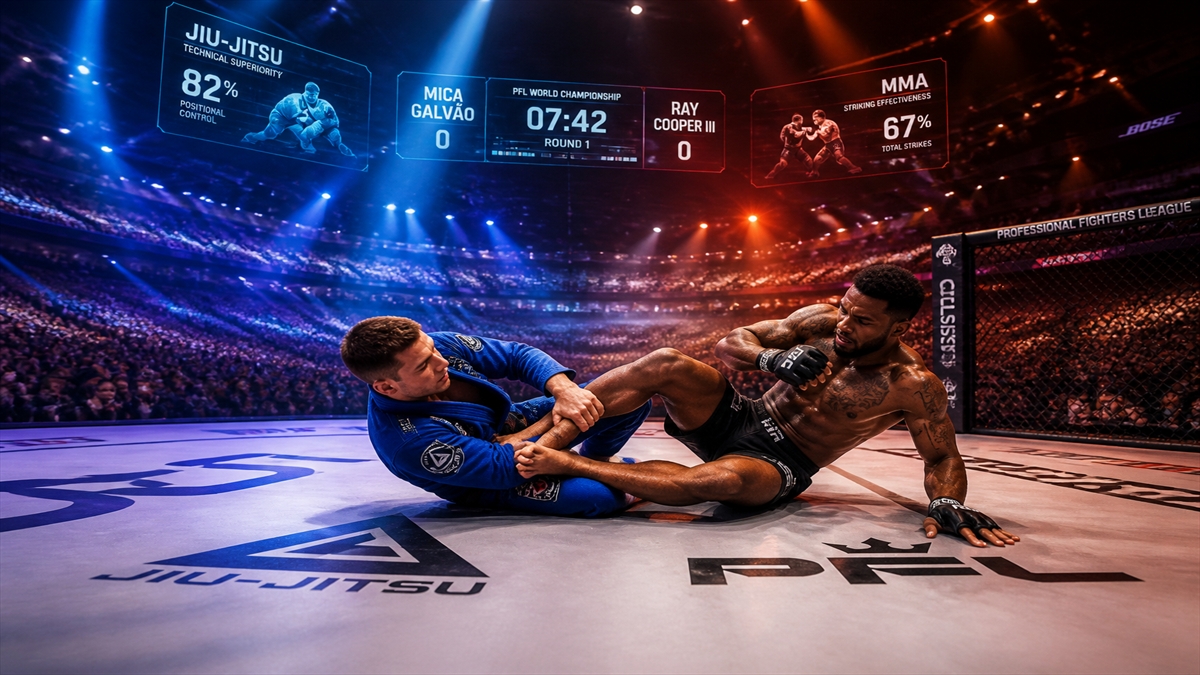
When Mikey Musumeci tapped Bryce Mitchell in front of millions of UFC fans, he didn't just win a grappling match—he accidentally revealed one of combat sports' most exploitable market inefficiencies. The flyweight jiu-jitsu wizard had crossed over from ONE Championship's submission grappling division to prove a point that's been obvious to anyone paying attention: there's a massive, underserved audience for high-level grappling content that doesn't require anyone to get punched in the face. The question isn't whether fans want to watch elite grapplers compete. The question is why major MMA promotions haven't built a permanent infrastructure to monetize this appetite.
The Structural Gap Musumeci Just Exposed
Traditional MMA operates on a simple premise: fighters must be willing to engage in all ranges of combat or they don't belong in the cage. But this binary thinking ignores a growing cohort of world-class athletes who possess skills that would mesmerize audiences but have zero interest in eating elbows for a living. Musumeci's callout for more MMA opponents after the Mitchell match wasn't bravado—it was a business proposal disguised as trash talk. He's essentially asking the industry: why doesn't a parallel track exist where guys like me can compete regularly against your roster without the brain trauma?
The UFC's current model leaves money on the table in three specific ways. First, elite IBJJF and ADCC competitors have no clear pathway to UFC-level exposure without completely changing sports. Second, aging MMA veterans with deteriorating chins but intact grappling games have no monetizable exit ramp. Third, international markets where grappling culture dominates—Brazil, Japan, parts of Europe—consume MMA content differently than American audiences, often favoring technical exchanges over knockout highlights. A permanent sub-only exhibition series addresses all three gaps simultaneously.
ONE Championship's Hybrid Blueprint
ONE Championship didn't stumble into this model by accident. Chatri Sityodtong recognized that Asian markets have fundamentally different combat sports preferences, with grappling and technical striking holding equal cultural weight to knockouts. By running submission grappling matches on the same cards as Muay Thai and MMA bouts, ONE created a content ecosystem that monetizes multiple audience segments without forcing athletes into uncomfortable crossover scenarios.
The financial mechanics are straightforward. Submission grappling matches cost less to produce than full MMA fights—smaller medical staff requirements, lower insurance premiums, reduced regulatory overhead in certain jurisdictions. Fighters can compete more frequently because the recovery timeline from a grappling match is measured in days, not months. Musumeci himself has competed multiple times per year under ONE's banner, building a casual fanbase that would be impossible if he needed twelve weeks between fights to let facial fractures heal.
The sponsorship appeal is equally compelling. Technical grappling attracts corporate partners who want association with athleticism and strategy rather than violence. You can sell high-end watches and luxury vehicles against the backdrop of intricate leg entanglements in a way that becomes awkward when the preceding fight featured someone getting knocked unconscious. ONE's grappling division has secured endemic sponsors from the jiu-jitsu industry while simultaneously appealing to mainstream Asian brands looking for combat sports credibility without the optics problem.
The Business Case for Permanent Exhibition Infrastructure
Building a sub-only division isn't about creating competition for traditional MMA—it's about expanding the total addressable market. The UFC's current roster management strategy already includes fighters who would thrive in this format. Demian Maia's final years demonstrated the problem clearly: a grappling genius whose striking deficiencies limited his championship viability, yet whose mat work alone could headline cards if the promotion had infrastructure to support it. How many more years could the UFC have monetized Maia's expertise if he could compete quarterly in submission-only matches while his neurological health remained intact?
The international talent acquisition angle is perhaps most compelling. Right now, the UFC recruits heavily from regional MMA circuits, which means they're fishing in a limited pond. A permanent grappling division opens recruitment pipelines into IBJJF black belt divisions, ADCC medalists, and national wrestling programs—athletes who might never throw a punch professionally but would sign exclusive contracts for the right platform. This isn't hypothetical. Gordon Ryan built a million-dollar grappling career without ever considering MMA because the economics finally made sense to stay specialized.
Fighter longevity becomes a legitimate selling point for both athlete recruitment and fan investment. MMA careers average seven years before accumulated damage forces retirement. Elite grapplers compete into their forties. From a promotion's perspective, that's decades of content generation from a single athlete acquisition. From a fighter's perspective, that's a career path that doesn't end with slurred speech and memory problems. The calculus shifts entirely when you remove repetitive head trauma from the equation.
Format Differentiation from Existing Grappling Leagues
The key differentiator for an MMA promotion's grappling division would be integration, not isolation. Existing grappling leagues like Polaris and Who's Number One operate in their own ecosystem, which limits crossover appeal. But imagine if every UFC pay-per-view featured one submission grappling match in the prelims—a technical showcase that serves as counterprogramming to the violent main card, giving audiences a palette cleanser while keeping them engaged during the broadcast.
The competitive format needs to deviate from traditional gi or no-gi rulesets to maintain distinctiveness. Shorter rounds with more aggressive restart penalties, overtime sudden-victory periods, or point-based systems that reward submission attempts over positional stalling. The goal isn't to replicate IBJJF rules—it's to create a spectator-optimized product that casual fans can follow without understanding the minutiae of advantage points. Think of it as the three-point line in basketball: a rule innovation that fundamentally changed how the game is watched and wagered on. Speaking of which, the betting infrastructure for grappling matches remains primitive compared to MMA, creating opportunities for sportsbooks to develop new prop markets around submission types, round prediction, and positional betting—appealing to the same audience that obsesses over live odds tracking during fight nights.
Addressing Fighter Safety While Expanding Revenue
The CTE conversation in combat sports has reached an inflection point. State athletic commissions are implementing stricter medical protocols, insurance costs are rising, and long-term liability concerns are forcing promotions to reconsider the sustainability of their current models. A permanent grappling division offers a rare win-win: it addresses legitimate safety concerns while simultaneously opening new revenue streams.
Fighters aging out of competitive MMA have historically faced grim options—retire early and lose income, or continue fighting with diminished abilities and accept catastrophic risk. Exhibition grappling provides a third path. Imagine a forty-year-old veteran with a decorated career but a deteriorating chin transitioning to quarterly grappling matches at a fraction of the purse but also a fraction of the risk. The promotion maintains a recognizable name for marketing purposes, the fighter extends their earning window, and nobody ends up with permanent neurological damage. It's the combat sports equivalent of a designated hitter rule—acknowledging that specialized skills have value even when complete skill sets deteriorate.
The audience appetite for technical mastery over violent finishes is already evident in viewing patterns. YouTube breakdowns of grappling exchanges routinely outperform knockout compilations in watch time and engagement metrics. Reddit threads dissecting submission sequences generate more substantive discussion than highlight-reel KOs. The conventional wisdom that casual fans only want violence doesn't hold up under data scrutiny—they want comprehensible excellence, and modern grappling has become significantly more accessible to lay audiences than it was a decade ago.
MMA's Answer to Boxing's Exhibition Economy
Boxing figured out years ago that exhibitions and specialty matches could generate massive revenue without the promotional commitment of title fights. Floyd Mayweather's post-retirement exhibition matches proved that spectacle and technical display could coexist profitably. MMA has been slower to embrace this model, partly because the sport's younger demographic demands authenticity and partly because the UFC's monopolistic market position reduced pressure to innovate.
But the landscape is shifting. Bellator, PFL, and ONE are all experimenting with format variations and crossover matches. The promotion that establishes a credible, permanent grappling infrastructure first will have first-mover advantage in signing the next generation of elite grapplers before they commit to pure grappling organizations. It's the same strategic calculus that drove the UFC's early investment in women's divisions—recognize an undervalued talent pool before competitors do, then build marketing infrastructure around it.
Musumeci's viral moment with Mitchell provided proof of concept for what many in the grappling community have known for years: elite submission grappling is ready for prime time if someone bothers to present it properly. The technical barrier to entry for casual fans has lowered dramatically thanks to improved commentary, better camera angles for ground work, and a generation of fans who grew up watching BJJ breakdowns on social media. The infrastructure gap isn't on the demand side—it's on the supply side.
Implementation Roadmap for Promotions
The practical steps for launching a permanent exhibition division are less complicated than the political will required to execute them. Start with quarterly events featuring four to six grappling matches, co-promoted with existing MMA cards to leverage existing production infrastructure. Recruit a mix of established names from the promotion's current roster who want to extend careers and outside talent from ADCC or IBJJF circuits looking for mainstream exposure.
Revenue sharing needs to differ from traditional MMA structures. Grappling-only athletes should receive smaller base purses but higher percentages of sponsorship revenue and merchandise sales, acknowledging they're taking less physical risk while still generating content value. Performance bonuses should reward technical excellence and crowd engagement rather than simply finishes, creating incentive structures that align with the division's stated goals.
Broadcasting partnerships could follow the ONE Championship model—integrate grappling matches into existing streaming deals while potentially packaging them separately for international markets where grappling culture is stronger. A three-year pilot program would provide sufficient data to evaluate commercial viability without requiring massive upfront investment.
The biggest obstacle isn't financial or logistical—it's cultural. MMA promotions have spent decades building brand identity around complete fighting systems and the warrior ethos of facing all challenges. Creating a parallel track that explicitly acknowledges some elite athletes prefer to avoid certain risks requires promotional humility that doesn't come naturally to organizations built on dominance narratives. But the Musumeci moment created permission for this conversation. When a 135-pound grappler can generate more social media engagement than half the UFC's recent main events, the market has spoken. The only question is which promotion will listen first and build the infrastructure to monetize what fans clearly want to watch.


