Why Passkeys Are Replacing Passwords Faster Than Anyone Expected
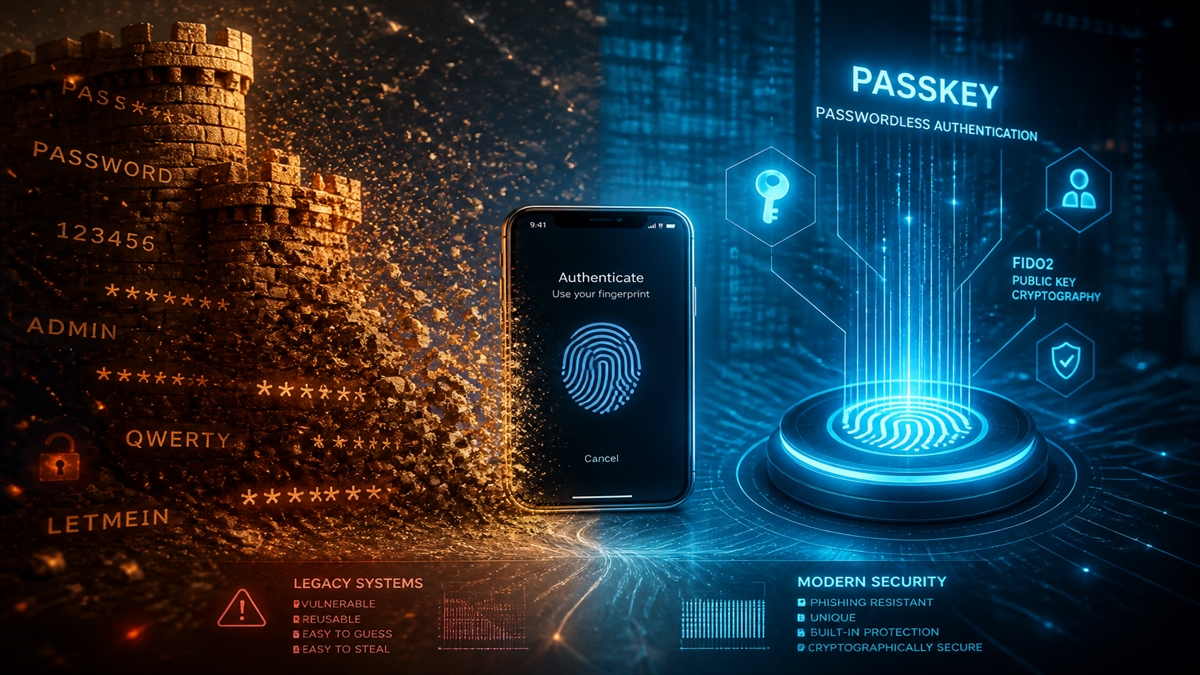
Three years ago, passkeys were a technical specification that most people had never heard of. The FIDO Alliance had published the standard, Apple and Google had announced support, and security researchers were cautiously optimistic. But mainstream adoption? That was supposed to take a decade.
It took three years. By the end of 2025, 69% of consumers had at least one passkey — up from 39% just two years earlier. Nearly half of the top 100 websites supported passkey authentication. Microsoft made passkeys the default for new accounts. And the FIDO Alliance's Passkey Index, drawing data from Amazon, Google, PayPal, TikTok, and Target, showed that 93% of user accounts across participating platforms were passkey-eligible. The password isn't dead yet, but it's on life support, and the machines keeping it alive are being unplugged faster than anyone predicted.
How Passkeys Actually Work
A passkey replaces your password with a cryptographic key pair. When you create an account or upgrade an existing one, your device generates two keys: a private key stored securely on your phone, laptop, or tablet (protected by biometrics or a PIN), and a public key sent to the website. When you log in, the site sends a challenge, your device signs it with the private key after verifying your fingerprint or face, and the site checks the signature against the public key.
No password is transmitted. No password is stored on a server. There is nothing to phish, nothing to leak in a data breach, and nothing to forget. The entire authentication happens in a single biometric gesture — a fingerprint scan or face unlock that takes roughly one second.
Why Adoption Accelerated So Fast
The speed of passkey adoption caught even its advocates off guard. Several forces converged simultaneously.
- Platform readiness arrived all at once. Apple, Google, and Microsoft integrated passkey support across iOS, Android, macOS, Windows, Chrome, Safari, and Edge within a compressed timeline. Over 95% of iOS and Android devices are now passkey-ready, and over 90% have the functionality enabled. The infrastructure problem — which had stalled earlier passwordless attempts — was solved before most consumers even knew what a passkey was.
- Major brands led by example. Amazon, Google, PayPal, TikTok, Microsoft, and Target deployed passkeys early, exposing hundreds of millions of users to the experience. Once people saw how fast and simple it was, they expected it everywhere else.
- The password problem got worse, not better. The average person manages over 300 credentials. Nearly half of consumers have abandoned a purchase because they forgot a password. Phishing attacks against banks increased by over 300% in a single year. The cost of maintaining password infrastructure — resets, support tickets, breach remediation — made the business case for passkeys obvious.
- Regulatory pressure mounted. The UAE mandated the elimination of SMS and email OTPs for financial institutions by March 2026. India followed with an April 2026 deadline. The EU Digital Identity Wallet rollout targets the end of 2026. These deadlines forced enterprises to move.
The Numbers That Matter
The performance gap between passkeys and passwords isn't marginal — it's structural.
| Metric | Passwords | Passkeys |
|---|---|---|
| Login success rate | 63% | 93% (FIDO Alliance) |
| Login speed | Baseline | 3x faster than passwords, 8x faster than password + MFA (Microsoft) |
| Phishing vulnerability | High credentials can be stolen | Zero — nothing to phish |
| Server-side breach risk | High — password databases are prime targets | None — no shared secret stored |
| Cart abandonment from forgotten credentials | ~50% of consumers affected | Eliminated — biometric unlock only |
| Enterprise authentication cost | Baseline | 87% reduction (Microsoft) |
TikTok reported a 97% success rate with passkey logins. Google found passkey sign-ins four times more successful than passwords. HubSpot saw a 25% improvement in login success rates and 4x faster login times after deploying passkeys in late 2024. The security and convenience improvements compound across every platform that adopts them — whether that's a banking app, an e-commerce checkout, or an nvcasino online gaming platform where fast, secure authentication lets players move from login to live dealer tables and slot lobbies without friction.
What's Still Holding Passwords in Place
Passkeys haven't eliminated passwords entirely, and several friction points remain. Cross-platform portability was a significant barrier until recently. Apple's iOS 26 introduced credential import and export features, and the FIDO Alliance's Credential Exchange Format now allows passkeys to move between providers. But the process isn't seamless yet, and users with mixed ecosystems — an iPhone and a Windows laptop, for example — still encounter friction.
Legacy systems also resist change. Enterprise applications built on decades-old authentication frameworks can't simply swap in passkey support without architectural changes. For modern platforms, integration is now a matter of weeks — the same streamlined approach that lets a player jump straight into a roulette online NV casino session with a single biometric tap, place real-money bets on European or American wheel variants, and cash out winnings without re-entering credentials. For legacy systems, it remains a multi-quarter migration.
The Trajectory Is Clear
The remaining barriers are logistical, not fundamental. The technology works. The user experience is superior by every measurable metric. The security model eliminates the most common attack vector in digital fraud. And the largest platforms in the world have already made the switch. Passwords will persist in legacy corners of the internet for years, but as the default authentication method for any new service, their time is over.


