The Anti-Doping Double Standard: Why a 1-Year Suspension for a Mid-Tier Welterweight Reveals the UFC's Inconsistent Enforcement Problem
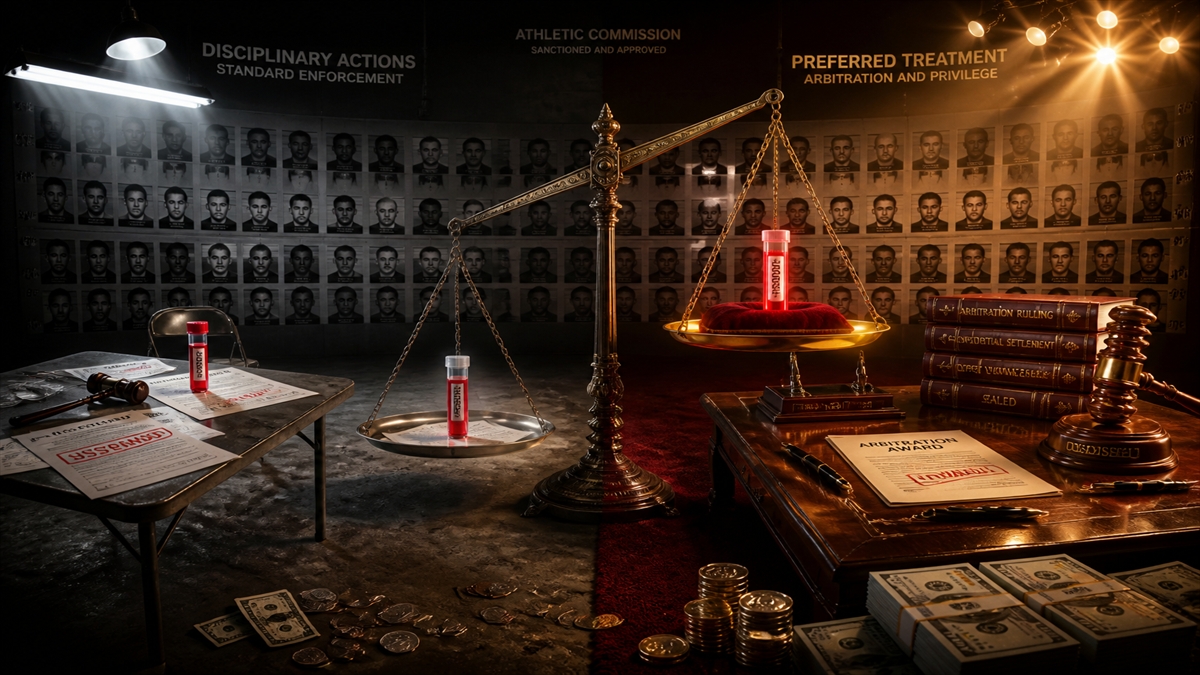
When news broke of another UFC welterweight receiving a one-year suspension for an anti-doping violation, the MMA world barely noticed. No headlines. No extended debates on podcasts. No impassioned social media defenses. The fighter's name didn't even trend. And that's exactly the problem.
Because when you're a mid-tier fighter without millions of Instagram followers or pay-per-view points, the rulebook suddenly becomes very clear. Very rigid. Very enforceable. But if you're a main event draw who can move betting lines and sell out arenas? Well, that's when the UFC's anti-doping enforcement starts looking less like justice and more like a casino deciding which players get comped rooms.
The Tale of Two Testing Positive
Let's examine the evidence without tinfoil hats. In 2017, Jon Jones tested positive for Turinabol metabolites ahead of UFC 214. USADA initially recommended a four-year suspension. Jones eventually received 15 months after arbitration, with the UFC standing firmly behind their biggest light heavyweight star throughout the process. Dana White called it a "tainted supplement" issue and kept Jones' comeback door wide open.
Fast forward to lesser-known fighters. In 2019, Nicco Montaño—the inaugural women's flyweight champion who never became a draw—received a two-year suspension for EPO use. No benefit of doubt. No reduced sentence through arbitration headlines. Her career essentially ended.
The pattern isn't subtle. It's as obvious as a poker tell to anyone watching closely enough.
The Economics of Selective Enforcement
Here's where this connects to broader business principles that would make any MBA program salivate. The UFC operates like any other entertainment corporation—they have assets that appreciate and depreciate based on market demand. A fighter who generates $5 million in gate revenue is fundamentally more valuable than one who draws regional-level numbers.
When a star tests positive, the UFC faces a decision tree:
- Option A: Enforce strictly, lose millions in scheduled bout revenue, anger broadcasters and sponsors
- Option B: Navigate gray areas, support fighter through appeals, minimize reputational damage, preserve asset value
For replaceable athletes, there's no calculation needed. The cost-benefit analysis is simple: enforce, replace, move forward.
This creates what economists call a "moral hazard"—when one party takes risks because another party bears the cost. Stars know they have institutional backing. Undercards know they're disposable.
Case Studies in Contradictory Justice
Consider Conor McGregor's testing pool situation. In 2021, McGregor left the USADA testing pool, which requires six months of testing before returning to competition. When he announced his 2024 return, questions arose about compliance timelines. The UFC navigated this with corporate precision—delaying, explaining, making it work. Imagine if a fighter ranked 14th in the welterweight division tried the same maneuver.
TJ Dillashaw received a two-year EPO suspension in 2019, but as a former champion with drawing power, his return was marketed as redemption. Lesser-known fighters with identical violations often face career-ending silence.
Brock Lesnar tested positive for clomiphene and hydroxy-clomiphene at UFC 200. He received a one-year suspension, but more importantly, the UFC had already paid him millions and promoted the fight knowing he'd failed pre-fight screening. Would they have proceeded with that financial commitment for a prelim fighter? The question answers itself.
The USADA Illusion of Impartiality
The UFC partnered with USADA in 2015, supposedly creating an independent anti-doping program that would clean up the sport. In theory, USADA operates outside UFC influence. In practice, the UFC controls fighter contracts, promotional opportunities, and ultimately, who stays employed.
USADA can suspend. The UFC decides if there's a career to return to.
It's like hiring a security company for your casino but still controlling which high rollers get escorted out versus which ones get a stern warning and a complimentary suite upgrade.
What This Means for Betting Markets and Competitive Integrity
Here's an angle most coverage misses: this inconsistency directly impacts gambling markets. When oddsmakers set lines, they're calculating probability based on assumed fairness—that both fighters are competing under identical rules with identical enforcement.
But if enforcement is selective, if certain fighters receive institutional protection while others face immediate consequences, the entire foundation of fair odds crumbles. Bettors placing money on fights are unknowingly wagering in a rigged game—not because fights are fixed, but because the playing field isn't level before fighters ever enter the octagon.
Crypto betting platforms, which pride themselves on transparency and blockchain-verified fairness, face a philosophical problem: how do you ensure fair wagering when the sport itself operates with hidden asymmetries?
The Essay Every Fighter Should Write
If you're a college student writing an essay on institutional power dynamics, the UFC's anti-doping enforcement provides a perfect case study. It demonstrates how formal rules (written policies) differ from informal rules (actual enforcement), how economic incentives override stated values, and how organizational behavior reveals true priorities regardless of public messaging.
The parallels extend beyond sports. Corporate America operates similarly—executives receive golden parachutes for failures that would get entry-level employees immediately terminated. The rules exist, but their application depends on your organizational value.
Where Do We Go From Here?
The UFC announced they're ending their USADA partnership in 2024, transitioning to a new program. Whether this represents an opportunity for reform or further entrenchment of the double standard remains unclear.
What we know: the current system punishes the powerless while protecting the powerful. A one-year suspension for an unnamed welterweight barely registers as news because we've accepted this inequality as normal. We've normalized a justice system where your punishment depends not on your violation, but on your value to the promotion.
That unnamed welterweight will serve his suspension, likely return to obscurity, maybe get cut after a loss or two. Meanwhile, stars with similar violations get documentary series about their comeback, featured spots on pay-per-view cards, and redemption narratives carefully crafted by UFC public relations.
The difference isn't in the substance they tested positive for. It's in the substance of their drawing power. And until the UFC decides competitive integrity matters more than quarterly earnings, that won't change.
Because at the end of the day, the house always protects its best players. Even when they're caught counting cards.


